Te Reo Māori Videos!
#184: here, there by you with ko...
kō ,konei, tonā, korā
Te reo Māori has two distinct sets: tēnei/tēnā/tērā (and plurals ēnei/ēnā/ērā) for things near me, you, or over there. The second set—konei, konā, and korā—refers specifically to places, meaning "here where I am," "there where you are," and "over there," and these have no plural forms. When talking about movement to a place, add ki (as in ki konei), while i indicates position or movement from a place.
#185: Don't talk like that!
pēnei, pēna, pēra
Here is a grammar outline based on the examples provided:
The particles **pēnei** (near me), **pēnā** (near you), and **pērā** (over there) are demonstrative adverbs meaning "like this/that." They indicate proximity and are used with verbs to describe how an action is performed. When comparing, they are often followed by i ("like" + noun).
#186: Lift the baby carefully so you don't hurt her!
āta... kei...
Āta marks that an action is done carefully or slowly, and it typically accompanies passive verb forms. The particle kei introduces a warning of a potential negative outcome. In passive commands with āta, the object follows directly without the preposition i, while the kei clause spells out the risk to avoid.
#187: Particles in the preposed periphery
mātua
Māori has preposed particles (before head words: āta, tino, āhua, mātua, tense markers, determiners) and postposed particles (after: atu, tonu, hoki, kē, ana). Some structures use both (e…ana). Mātua implies "first and foremost" (priority), unlike tuatahi ("firstly").
#188: Rangi will eat that cake over there
te ___ nei, te ___ nā, te ___ rā
Māori demonstratives—tēnei (near me), tēnā (near you), tērā (over there)—can be single words or split as te...nei/nā/rā around a noun. For agent emphatic, past uses nā + agent + i + verb (object takes no i), future uses mā + agent + e + verb. The demonstrative may precede or follow the noun.

#189: Rangi will help Mere
Agent emphatic
Agent emphatic sentences (past nā, future mā) place the subject/agent first, then the object (no i), then verb (i past, e future). With two people, the first is the doer, the second the receiver: Māku koe e āwhina = I'll help you. Māu ahau e āwhina = you will help me.
#190: Jude will have our food
hei
"Hei" marks the future locative (where someone/something will be), contrasting with present kei and past i. Used with a for personal possession (hei a Jude = will be with Jude). It indicates future location, not purpose—distinct from mā (for the benefit/consumption of).
#191: It will be next week that I will go to the supermarket
hei... ka... ai...
Use *hei* to say where or when something will be. For time, it's like saying "it'll be *then* that..." Add *ka...ai* to connect the time to the action—think of *ai* as glue sticking two ideas together. It's all about emphasising the *when*, similar to how we emphasise *who* did something.
#192: One day these children will be respected elders
hei
Hei marks a **future purpose**—what an object will be used for (e.g., pen *for writing*, knife *for cutting meat*, box *used as a table*) or a **person's future role/job** (e.g., *will be a doctor*, *will be elders*). It never describes present actions, only intended or eventual functions and positions.
#193: What do I care if my ex gets married?
hei aha? he aha to...
Hei marks future location, time, purpose, or role. Hei aha? asks purpose ("what for?"). As a kīwaha, hei aha + noun means "never mind/don't worry about." With māku/māu/māna, it becomes "what does it matter to me/you/him?" – expressing indifference or irrelevance.
#194: I go to the beach in order to relax
ki te ...ai.
Ai marks habitual action (waiata ai ia) and reason in he aha... ai (why). With movement verbs, ki te... ai means "in order to" (purpose), e.g., haere ki te hokomaha hoko kai ai. Unlike plain ki te + verb, it emphasizes reason, but only works with verbs of motion (not sitting).
#195: For the purpose of someone else doing something
Kia... ai
The **kia... ai** structure links two clauses with different subjects: the first subject facilitates the second subject’s action. Use *kia* + verb in the dependent clause, and *ai* at the end of that clause to express purpose ("so that/in order that"). Example: *Homai te pukapuka kia pānui ai au* – "Pass the book so I can read."
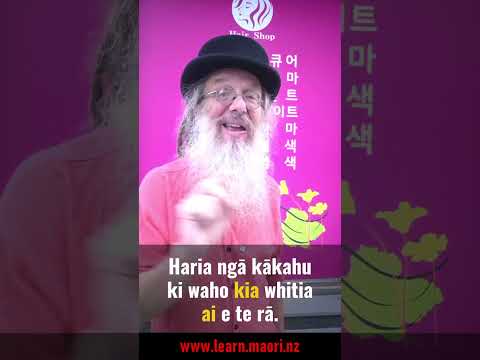
#196: Kia... ai with passives
Kia ai
Use *kia... ai* when two clauses have different subjects: the first action facilitates the second's desired outcome or state. It frequently pairs with passive verbs (e.g., *kitea*, *hokona*) to express an intended result, like ensuring something is seen, dried, or bought.

#197: Kia... ai with statives
kia... ai
Kia... ai marks a purpose or intended outcome of an action. It takes a passive (whakakīa) to emphasize the action done to the subject, or a stative (kī, mahue, pai, ora) to describe the resulting state. It translates as "so that" or "in order for" something to occur.

#198: In order to
hei
Hei indicates purpose ("in order to") or role/function ("as"). It follows the main verb, requires the same subject in both clauses, and cannot be used with passive verbs.

#199: Belonging to the buying of food was my going to the supermarket
nā... i... nei
Nā... i... ai, expresses purpose as a reason: Nā te hoko kai i haere ai au – "to buy food." This builds on nā/nō's four other roles: agent emphasis (Nā Rangi), past possession (Nā Rangi tēnei), origin (Nō Ahuriri), and time (Nā tērā wiki).
#200: I am leaving because of the crying of the baby
nā... e... ai
Use nā + reason/cause, then the affected person/thing, then verb with i... ai (past) or e... nei (present). Order: Nā [cause] [affected] i [verb] ai (past) or nā [cause] [affected] e [verb] nei (present). Explains because of X, Y happened/is happening.
#201: The reason why something will happen
mā... e... ai
Use nā for past/present reasons (nā...i...ai; nā...e...nei), but mā for future (mā...e...ai). This mirrors agent emphatic (nā/mā) and possession (nā/nō, mā/mō) rules. The cause is present, the effect future (e.g., Māku a Rangi e harikoa ai – I’m the reason Rangi will be happy).
#202: I am going to the house where I grew up
ai
A sentence can contain two ideas that are connected. In te reo Māori, ai can help connect these ideas. One important use is i...ai, which can describe a place connected to an action. For example, te whare i tipu ake ai ahau means “the house where I grew up.” Here, ai links the place with the action.

#203: The house grew up
i... ai
Māori uses i ... ai for past relative clauses meaning “where.” i marks past action; ai links the clause back to the earlier place. Ai is obligatory: without it, “the house where I grew up” becomes “the house that grew up.”

#204: It was to the house that I went
ai
In past Māori sentences, when a location is fronted and motion is to/from it, put ai after the verb. With haere mai or haere atu, ai follows those words.
#205: It will be to the top of the mountain that the warriors will climb.
ai
When a location is fronted before a motion verb, put ai after the verb. Past uses i...ai; future uses e...ai. This emphasizes the destination or origin. Example: Ki te motu i kauhoe ai te wahine.

#206: Rangi drank beer, then he got drunk, then he threw up
ka.... ai
The Māori structure ka… ai means “and then,” similar to kātahi ka. Both show sequence, but ka… ai presents the second event as following or resulting from the first, while kātahi ka mainly stresses chronological order. Example: I waiata ahau, ka kanikani ai ahau.
#207: I am going to the house where I live
Ai
In Māori, use ai when extra information about a noun contains a verb (a relative clause), e.g. te whare e noho ai ahau. Omit ai when the modifier is non-verbal—adjective, possessive, or descriptive phrase, e.g. whare kākāriki, tōku whare. One important exception exists.

#208: Mere is baking the cake that Rangi will eat
ai
The five-question ai rule: when adding information, ask what it describes, what the new info is, and whether it has a verb. If so, check who does it. If that actor differs from the described thing, use ai; otherwise don’t.

#209: Mere is angry at Rangi who was arrested by the police
ai
Use five questions: what are you adding info about? What is the info? Does it contain a verb/action? Who performs that action? If that actor differs from the thing described, use ai; if not, don’t. Example: Rangi crying—no ai; police arresting Rangi—ai.
#210: The mother is talking to the children who are playing
ai
Five questions decide if ai is needed. Identify the noun being described. If the added info has no verb, no ai. If it has a verb, compare the doer with that noun: different doer → ai; same doer → no ai. Examples: children who are happy/playing = no ai; children she loves = ai.
#211: The mother is talking to the children who are loved by her
ai with passives
In a passive sentence, the affected thing becomes the subject and the doer is marked by e. In Māori subclauses, use ai when the described noun differs from the subclause’s subject. Same → no ai; different → ai.

#212: "Ai" in the carburettor of te reo
ai
I put 17,000 sentences into a database and found it’s the 14th most common word in te reo Māori. About 10% of sentences use it. The rules around the use of ai seem obscure - but is essential grammar and so we can’t ignore it.
#213: Ai with statives
ai with statives
In Māori, active verbs make the doer the subject; statives make the affected thing the subject. In subclauses, use ai when the subclause subject differs from the antecedent, and omit it when they are the same—so active verbs often need ai, statives often don’t.
#214: Rangi mistakenly believes his singing is beautiful
pōhehe, pēnei ai
Māori expresses mistaken belief two ways: pōhēhē means “be wrong/mistaken,” often implying ongoing delusion and sometimes criticism; pēnei au means “I thought,” typically a past mistaken assumption now realized, often contrasted with engari (“but actually”).